Explore this article
Quick answer
What this article explains
A practical JUSTPLUSH perspective on plush toy quality control: what we inspect before shipment for Procurement teams, importers, brand owners, retailers, licensing companies, quality managers, and custom plush buyers..
Start with the emotional role, not the factory specification
A character becomes easier to develop when the team can explain what the audience should feel when they first see and hold it. Comfort, humour, confidence, collectibility, nostalgia, and brand recognition lead to different decisions in posture, facial expression, softness, scale, and material. Writing this emotional role into the brief gives designers and production teams a shared reference when trade-offs appear.
The brief should also define the intended user, sales environment, product role, target size, expected quantity, launch window, and non-negotiable identity cues. These details prevent the project from becoming a sequence of subjective revisions.
Translate two-dimensional character identity into physical form
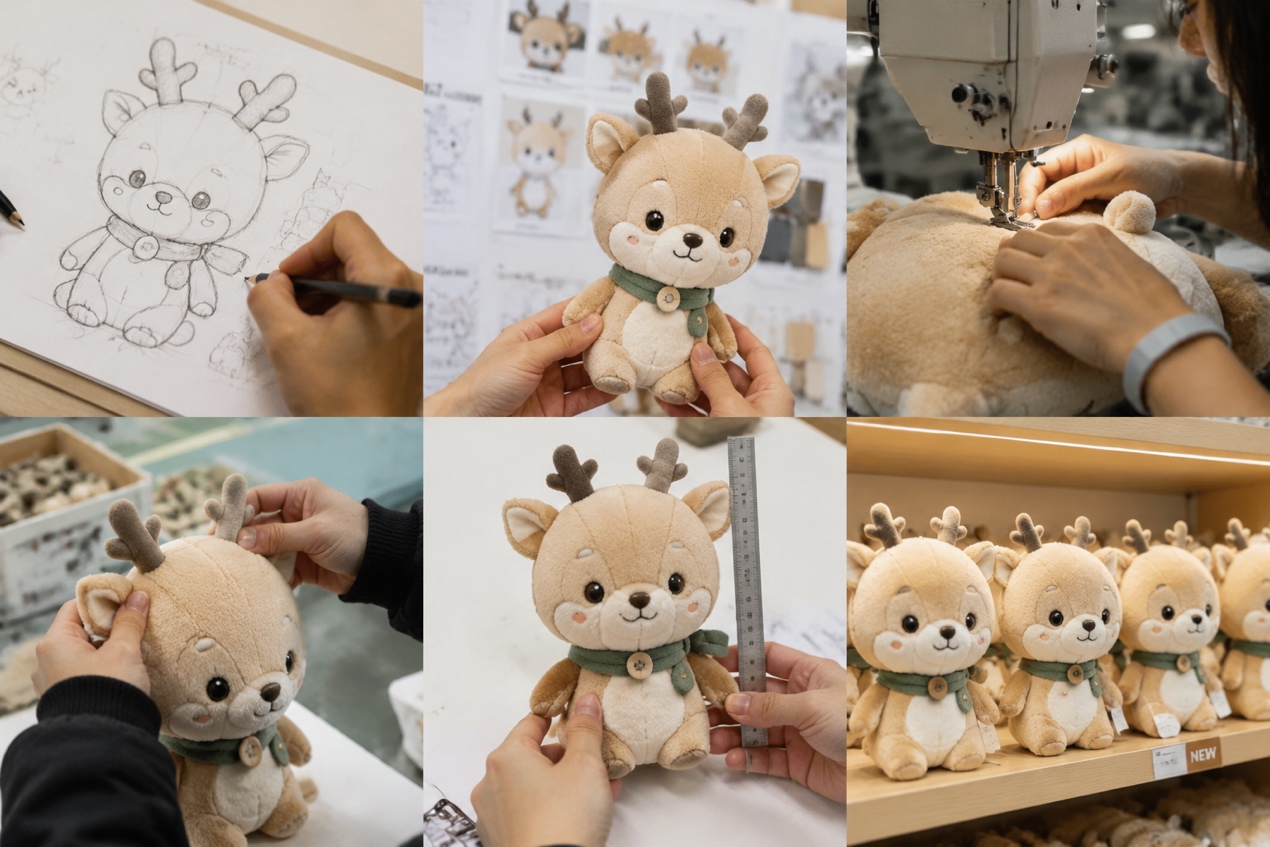
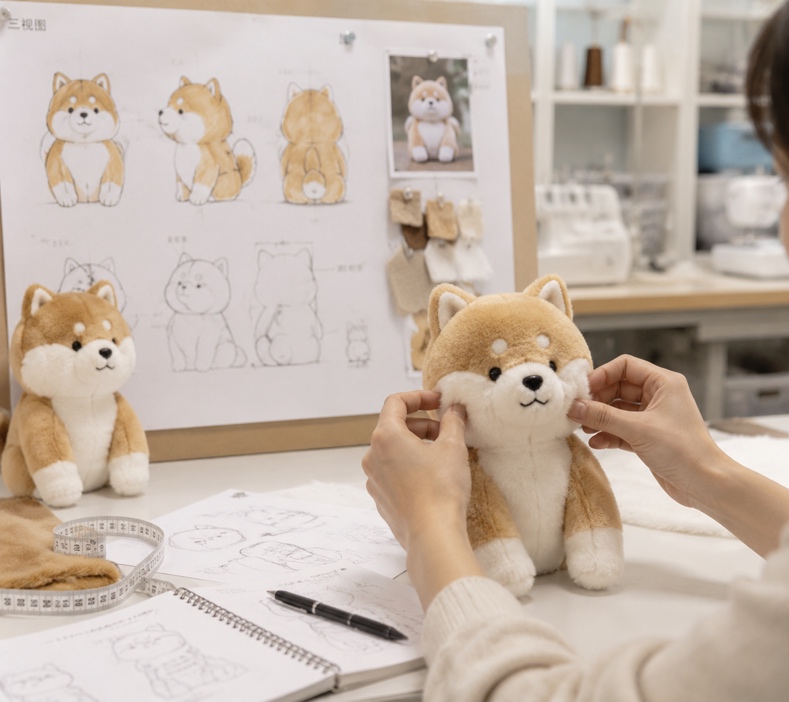
Illustrations can rely on impossible curves, floating details, extreme expressions, or a single flattering angle. A plush product must work from the front, side, back, and while being held. Development therefore requires decisions about head-to-body ratio, centre of gravity, seam placement, limb attachment, embroidery scale, and how the character sits or stands.
- Identify three to five visual features that must remain recognisable.
- Decide which flat graphic details become embroidery, appliqué, print, or constructed parts.
- Review the silhouette at thumbnail size before refining minor decoration.
- Check how the product looks when compressed, displayed, carried, and photographed.
Choose materials as part of the character language
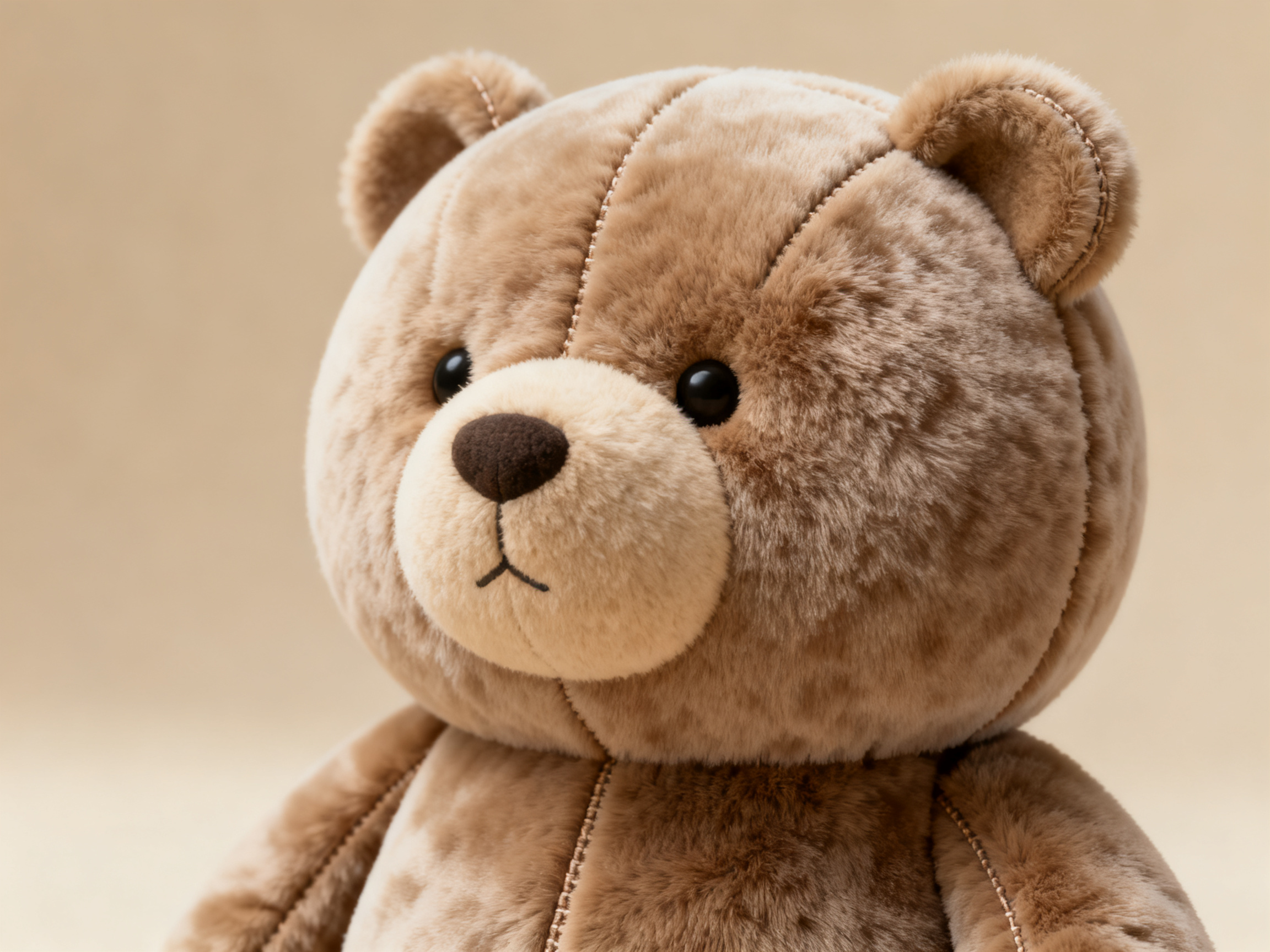
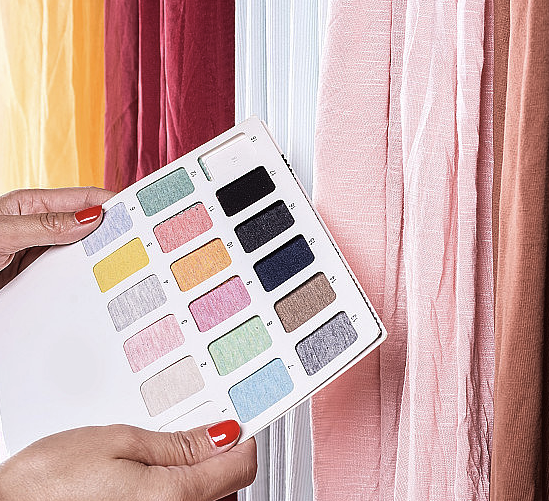
Fabric is not simply a colour carrier. Pile length, density, direction, stretch, sheen, and hand feel change the perceived personality of the same shape. Short plush can make graphic details clearer, while longer pile may create warmth but hide seams and embroidery. A premium-looking digital render is not sufficient evidence; colours and textures should be reviewed on real fabric under relevant lighting.
Resolve production constraints before detailed artwork is frozen
Early feasibility review protects the creative concept. Small accessories may create safety or durability concerns. Narrow limbs can be difficult to turn and fill consistently. Dense embroidery can stiffen a face panel. Too many colours and fabric changes increase cutting, sewing, inventory, and quality-control complexity. Discussing these constraints early allows the team to simplify intentionally instead of making emergency compromises after sampling.
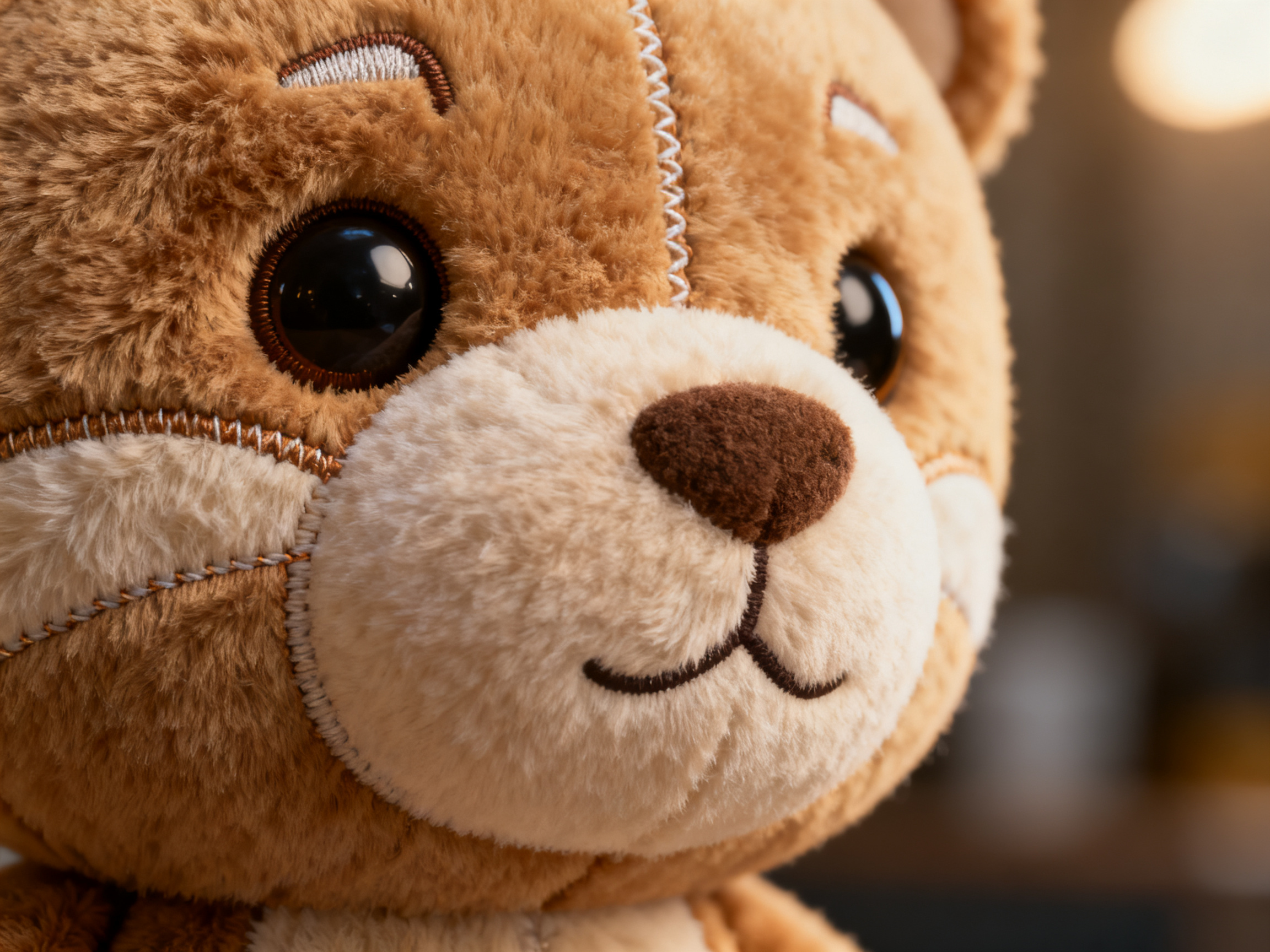
Example: turning a mascot illustration into a workable brief
Imagine a brand mascot drawn with an oversized head, very thin arms, a floating scarf, and a gradient face. The emotional intention may be friendly and energetic, but the illustration does not yet explain how the product should balance, how the arms should be filled, or how the gradient should be reproduced. A useful development brief would first protect the oversized head and recognisable scarf as identity priorities. It would then test a slightly wider arm pattern, anchor the scarf at safe construction points, and compare embroidery, appliqué, and print options for the facial colour transition.
The team should review each adjustment against the same question: does this change preserve the character's intended feeling while improving durability and repeatability? This prevents feasibility feedback from becoming arbitrary simplification. It also gives the brand a clear basis for approving an alternative when the original graphic detail cannot be reproduced literally.
Before sampling, the brief can define two acceptable scarf constructions and one preferred facial treatment. The first prototype then becomes a controlled comparison instead of an open-ended experiment. Photographs, material codes, embroidery dimensions, and comments from that round are retained so later decisions are based on evidence rather than memory.
Use sampling as a decision process
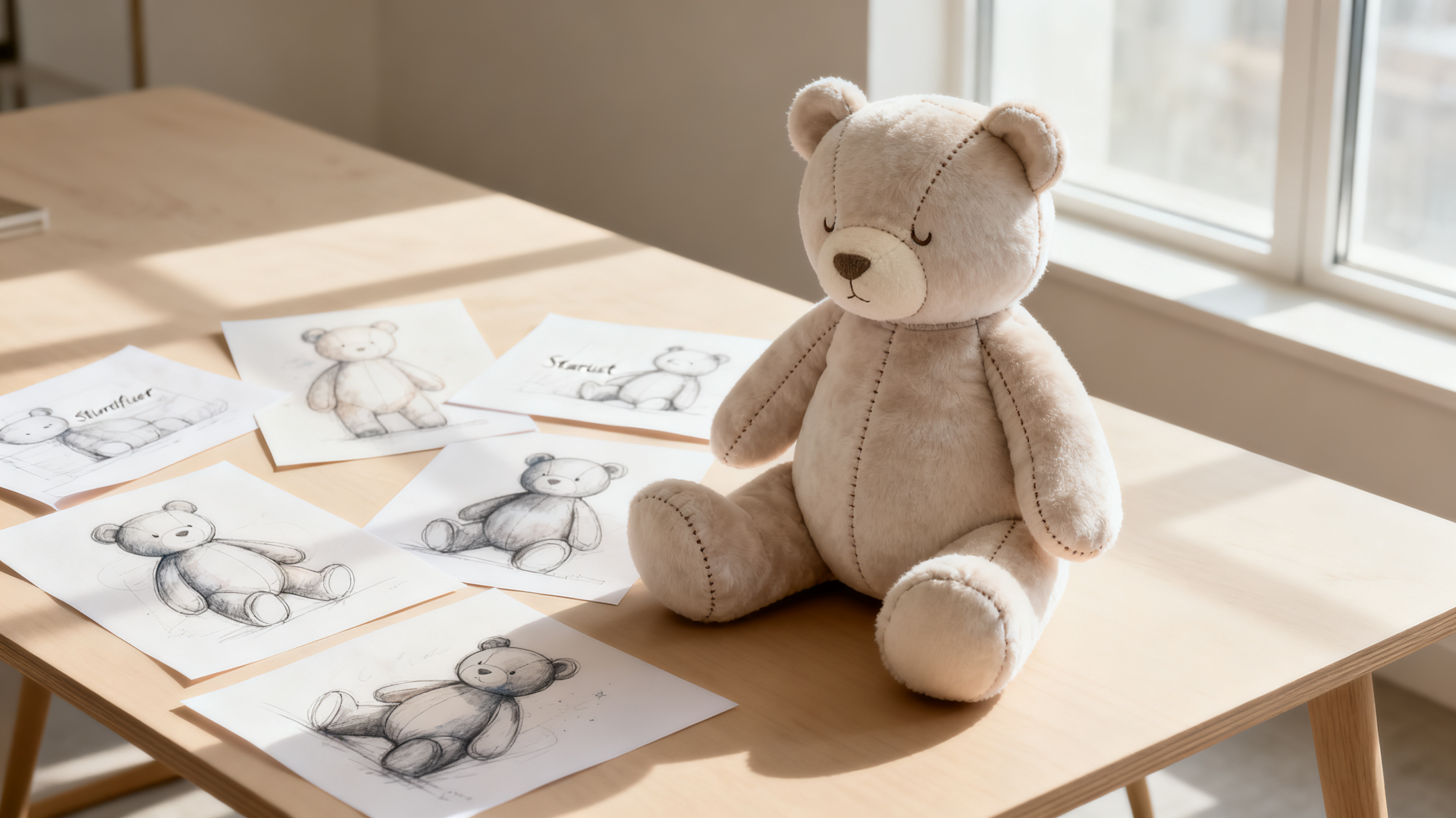
A first sample should answer defined questions rather than act as a vague attempt to make the drawing real. Review silhouette, expression, symmetry, balance, softness, structural stability, colour, detail durability, and packaging interaction separately. Photograph the sample from consistent angles and keep each revision linked to a written decision log.
- Round 1: proportion, construction, pose, and overall identity.
- Round 2: materials, colours, facial details, and hand feel.
- Round 3: production tolerances, labels, packaging, and final approval sample.
- Pre-production: confirm that approved details can be repeated consistently at scale.
Build a brief that both creative and production teams can use
The most useful handoff combines visual references with written intent. It records the audience, emotional objective, key proportions, front/side/back views, colour references, material preferences, required labels, packaging context, quantity range, schedule, and approval owner. It also distinguishes fixed brand elements from areas where the manufacturer may propose alternatives.
Common reasons promising concepts lose quality
Projects often struggle when the reference is attractive but incomplete, when every stakeholder gives unprioritised feedback, or when materials are selected from screen images alone. Another common issue is approving appearance without testing how the product sits, feels, photographs, and survives intended use. Clear decision ownership and evidence-based reviews are more valuable than adding more decorative detail.
Move from an approved sample to repeatable production
An approved sample is a reference, but scalable production also needs measurable instructions. Final patterns, fabric and colour codes, embroidery files, filling expectations, accessory placement, label positions, packaging method, and approved photographs should be consolidated into a controlled specification. Ambiguous comments such as “make it softer” or “make the face cuter” need to be translated into observable changes before production begins.
Pre-production review should focus on repeatability. The team checks whether different operators can reproduce the same expression and proportion, whether pile direction and seam allowance remain consistent, and whether packaging changes the shape during storage or transport. Small tolerance differences may be acceptable, but identity-defining details require clearer control points.
Quality review should therefore separate cosmetic variation from functional or brand-critical defects. A documented standard helps suppliers, inspectors, and brand teams make the same decision when evaluating a batch. This is especially important when a character will later expand into multiple sizes, costumes, seasonal colourways, or licensed collections.
A practical pre-development checklist
- Can the team describe the audience and emotional role in one sentence?
- Are the character's essential identity features ranked?
- Are front, side, and back views available or planned?
- Have fabric and colour decisions been checked physically?
- Are quantity, timeline, packaging, labels, and safety context known?
- Is one person responsible for consolidating feedback and approving revisions?
JUSTPLUSH perspective
At JUSTPLUSH, production-ready development means preserving the reason a character matters while translating it into repeatable physical decisions. The strongest projects give creativity and manufacturing equal attention: the emotional idea remains visible, and every important detail can be sampled, reviewed, documented, and produced consistently.
Frequently asked questions
What information should a brand prepare before requesting a plush sample?
Prepare character artwork, intended audience and use, target size, quantity range, launch schedule, reference colours, required details, packaging expectations, and any known safety or market requirements.
Does a character need complete three-view artwork before development starts?
Not always, but front, side, and back decisions must be resolved during development. Incomplete views increase interpretation risk and should be treated as an explicit design task.
Why can a plush sample look different from the digital artwork?
Fabric thickness, pile direction, stuffing, seam allowance, gravity, embroidery, and physical balance change how shapes and colours appear. Sampling translates the graphic idea into these physical conditions.
How many sample rounds are normally useful?
The number depends on complexity, but each round should have a defined purpose. Separating structure, materials, details, and production consistency makes revisions more efficient than changing everything at once.
How can brands reduce unnecessary revisions?
Use a ranked brief, appoint one approval owner, review samples against written criteria, and document every accepted decision with consistent photographs and comments.