Explore this article
Quick answer
What this article explains
Creating a plush product is not simply about making a character look cute. For character IP brands, the real challenge is turning emotion into a physical product that people can recognize, touch, hold, and emotionally...
Creating a plush product is not simply about making a character look cute. For character IP brands, the real challenge is turning emotion into a physical product that people can recognize, touch, hold, and emotionally connect with.
At JustPlush, we believe successful plush development begins before pattern making or material selection. It begins with emotional definition.
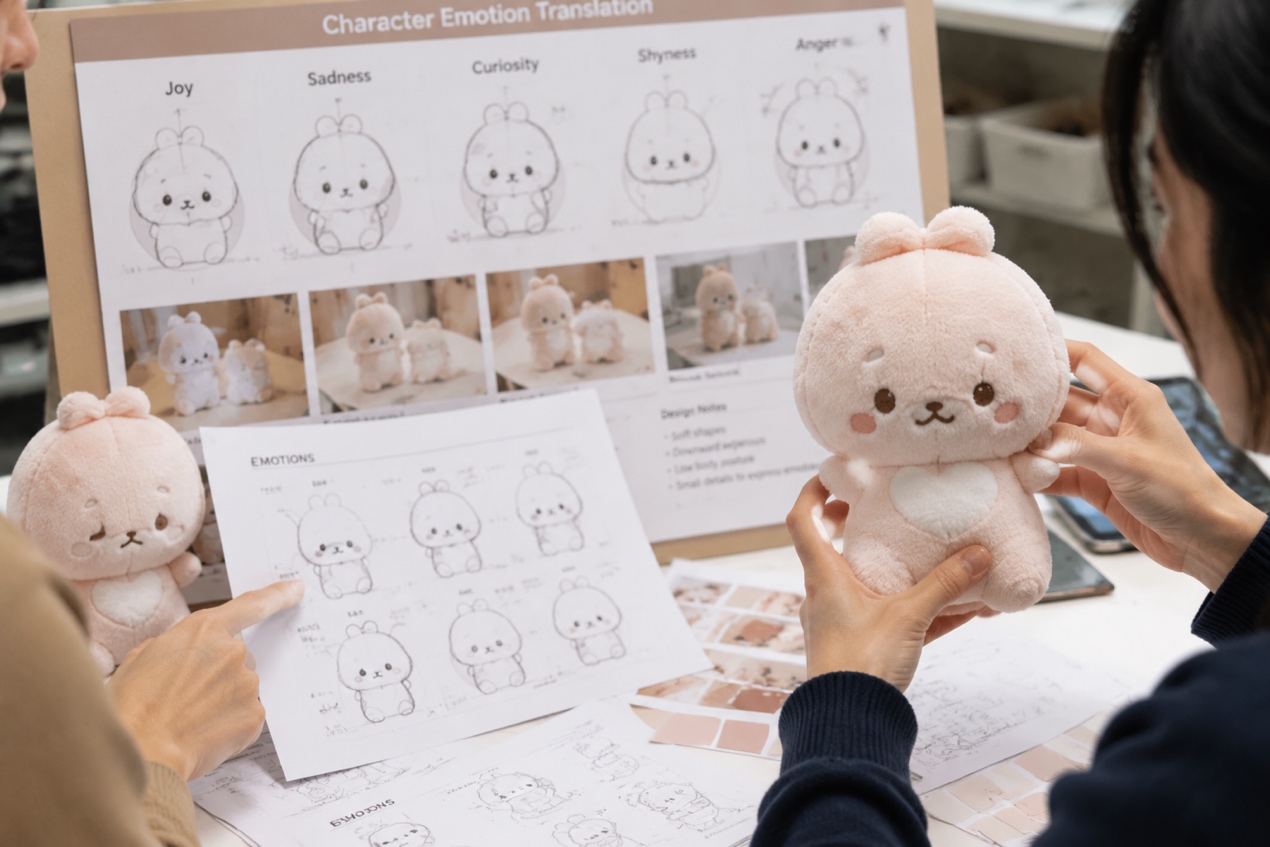
A strong plush product should not only reproduce a character’s appearance. It should translate the character’s personality into form language, structure, softness, and production-ready details.
Why Emotional Design Matters More Than Appearance Design
Many brands start with the question: “How should this character look?”
But for plush IP development, a better question is: “How should this character feel?”
Appearance can attract attention, but emotion creates attachment. A plush product is different from a flat illustration or digital character because people physically interact with it. They hold it, squeeze it, carry it, photograph it, and sometimes treat it like a companion.
This means that every physical detail carries emotional meaning.
A slightly lowered eye position can make a character feel more innocent. A rounded body can make it feel more approachable. A denser filling can make it feel more stable or serious, while a softer body can make it feel more vulnerable and comforting.
In plush design, emotion is not decoration. Emotion is structure.
Defining the Three Core Emotional Dimensions of a Character
Before we begin plush development, we often help brands define the emotional direction of the character. For many IP projects, we look at three key emotional dimensions:
1. Friendliness
Friendliness determines how approachable the character feels.
A highly friendly plush often uses softer curves, open facial spacing, relaxed posture, and a comfortable hand feel. This type of character feels easy to hug, easy to photograph, and easy to emotionally adopt.
For family brands, lifestyle brands, children’s products, and companion plush, friendliness is usually a key design direction.
2. Tension
Tension gives the character personality and memorability.
A character with no tension may look pleasant but forgettable. Tension can come from a mischievous expression, unusual proportions, a slightly awkward posture, or a contrast between softness and attitude.
This is especially important for modern IP brands. Many young consumers do not want a perfect mascot. They prefer characters with flaws, moods, and emotional complexity.
3. Curiosity
Curiosity makes a character feel alive.
A curious character may have slightly tilted eyes, an asymmetrical pose, a forward-leaning body, or small details that suggest movement and intention. Curiosity helps a plush feel less like an object and more like a personality.
For collectible plush, social plush, and lifestyle character products, curiosity can increase interaction and shareability.
Turning Emotion Into Physical Design Parameters
After defining the emotional direction, the next step is converting emotion into design parameters that can actually be produced.
This is where plush development becomes both creative and technical.
Eye Proportion Affects Emotional Recognition
Eyes are one of the fastest ways for consumers to read emotion.
Large eyes may create innocence, softness, or friendliness. Smaller eyes may feel calmer, cooler, or more mysterious. The distance between the eyes also changes the emotional effect. Wider spacing can make a character feel younger or softer, while closer spacing can create focus or tension.
However, eye design must also consider production. Embroidery thickness, fabric pile height, safety requirements, and scale consistency all affect the final result.
A beautiful eye design in a digital illustration may not work well on plush unless it is translated into a manufacturable form.
Softness Affects Personality
Softness is not only a material decision. It is also an emotional decision.
A very soft plush can feel comforting, gentle, and emotionally supportive. A firmer structure can make a character feel more confident, stable, or collectible. Some characters need a soft body but a more structured head. Others need weighted parts to create a sense of presence.
The right softness depends on the role of the product.
Is it a sleeping companion? A desk companion? A collectible mascot? A travel plush? A functional plush with internal components?
Each use case requires a different balance between emotional feel and structural stability.
Head-to-Body Ratio Affects Social Personality
The head-to-body ratio plays a major role in how people perceive a plush character.
A larger head often creates a stronger sense of cuteness, innocence, and character recognition. A smaller head with a longer body may feel more mature, humorous, or lifestyle-oriented.
For social media-friendly plush, the silhouette needs to be recognizable from different angles. For retail display, the product needs strong shelf presence. For portable plush, the proportions must also support easy carrying and photography.
This is why plush form language must consider both emotion and real-world usage.
Case Example: Translating DUKKI Into Plush Form
When developing a character like DUKKI, the goal is not to make a traditionally cheerful mascot. DUKKI’s personality is playful, slightly rebellious, and quietly chaotic.
That emotional direction affects every design decision.
An early sketch may focus mainly on visual cuteness. But during plush development, we need to ask more specific questions:
- Does the face feel too innocent?
- Does the posture express enough attitude?
- Is the body shape huggable but still unique?
- Can the expression be repeated consistently in mass production?
- Does the final plush still carry the character’s emotional tension?
In the refinement process, small changes can make a big difference. The eyes may become more focused. The mouth may become more subtle. The body may be adjusted to feel softer without losing the character’s personality. The head shape may be simplified so the pattern can hold its form after stuffing.
The final plush version should not simply copy the sketch. It should preserve the emotional identity of the character while making it physically touchable, durable, and production-ready.
From Emotion to Manufacturable Plush
The strongest plush products are created when emotional design and manufacturing logic work together.
- A character’s emotion needs to become a shape.
- The shape needs to become a pattern.
- The pattern needs to become a stable plush structure.
- And the final product needs to still feel like the original character.
At JustPlush, we help brands move through this full process — from character emotion and form language to prototype sampling and scalable plush manufacturing.
Because a successful plush IP is not only something people see.
It is something people feel.